Thursday, May 26, 2022

Thoughts On The Culture of Nice


                    Important To Be Nice!

Published on October 8, 2019

Brigette Hyacinth

 For far too long, being nice has been mistaken for being weak. In reality, niceness is an necessary quality of leadership for the world we’re living in. It has become so rare that when someone does a kind act or goes out of their way to be nice to someone, it goes viral on social media. Being nice doesn't mean you can't make hard decisions or stand up to difficult people, it just means you are respectful, kind, and show empathy to your employees.

When kindness isn’t modeled in the workplace, we find ourselves in an environment that is, unhealthy and at worst, toxic. Today people are clamoring for a more human style of leadership. In an age of automation and AI, leaders hard skills are easily being replicated by smart technology. What will make the difference in effective leadership is soft skills.

Here are 7 ways I've found being nice can bring you more success as a leader at work. You can start to encourage a culture of being nice to others by carrying out random acts of kindness during your day.

1. Be considerate: Hold the door open for the person behind you. If you are going to the water cooler, ask someone close to you if they would like you to fetch water for them also.

2. Smile at a colleague. When you make eye contact and smile at someone you are showing that they matter which gives them a boost of happiness.

3. Mind your manners. Say "Good morning" or "Hello" to colleagues more often.

4. Show appreciation: Be more vocal in your praise. Acknowledge the contribution and efforts of others.

5. Listen more. Learn to listen with the intent to understand. Don't just dismiss or ridicule others' viewpoints. Listening shows that you care.

6. Offer support and help to team members who are struggling.

7. Treat everyone with the same level of respect, whether it be the janitor or the CEO.

Everyone you meet is fighting a battle you know nothing about. Be kind always.

The way you treat others shows your values and true character. You can't influence others if you aren't authentic. Employees are looking at you as a leader to determine if they can trust you.

In my experience, tough and nice doesn’t have to be incompatible. Managers, please use the human-to-human approach when dealing with employees. It’s people you are dealing with, not just a statistic on a graph. Get to know your people, meet them where they are, and be flexible. Employees want to be treated as human beings.

In the end, people make companies successful. Any strategy or business plan relies on motivated and engaged people to make it happen! It's just like a relationship. For a relationship to last, there must be mutual respect, love, trust, understanding and appreciation. Without these, the foundation is shaky. This is why the most successful companies focus on people and relationships, and make sure both are not just managed but lead and cared for.

Monday, May 23, 2022

Decisions of Fear Wrong For Making Investments According to Article


Stock Market Reaction Shows that Decisions of Fear
Are Wrong for Investments

Newly developed scientifically predictable investment model shows that the recent market volatility is a result of instinctive response to fear rather than analytical response to economic indicators. The instinctive-response mode  makes investors “cut and run.” Conversely, the analytical-response mode, a.k.a. system 2, originates in the cortex and makes analytical decisions based on the economy.

The scientifically predictable model shows that the U.S. economy is strong and vibrant. Retail sales climbed 0.9% in April after an upwardly revised gain of 1.4% in March. This is a key economic indicator because consumer consumption makes up about 70% of Gross Domestic Product (GDP). Additionally, the economy added 428,000 jobs in April, for an average monthly gain of 523,000 over the past three months. The unemployment rate, at 3.6%, is near pre-pandemic level.

The instinctive-financial behavior today is the same as the behavior of our ancestors who faced uncertainty of survival from the elements and predatory animals. Although our fears today are more financially oriented, our instinctive response still originates from this part of the brain but is not suitable for investment decisions. The scientific study on the impact of money anxiety on financial decisions has been peer reviewed and published in the Journal of Applied Business and Economics.

When investors are exposed to negative news, economic, political or social, their level of money anxiety increases, which automatically generates instinctive response as part of their survival mechanism. Unfortunately, the instinctive response means “cut and run,” so they sell their stock and get out of the market. The same response our ancestors had when they saw lighting in the sky – they grabbed their food and wood and run into the cave.

The Scientifically Predictable Investing Model was designed to neutralize instinctive decisions by promoting the science of financial decisions. The model provides investors with a scientific projection of the featured equities, suggesting that investors follow the scientific projection rather than their instinctive response to sell when panicking. The Scientifically Predictable Investment Model provides peace of mind during volatile markets such as the one experienced in the last two weeks.

About Analyticom LLC
Analyticom LLC is a behavioral economics and finance firm focusing on developing predictive models for financial behavior. The company is a pioneer in developing a scientifically predictable model for the equity market based on the level of money anxiety. The Scientifically Predictable model projects the rate and return of ETF based on a predictor that is featured in the study “Dynamics of Yield Gravity and the Money Anxiety Index” and has been peer reviewed and published in the Journal of Applied Business and Economics.
Contact:

Dr. Dan Geller
Behavioral Economist
for Financial Services
Analyticom LLC
drgeller@analyticom.com
www.analyticom.com
415-891-3093

Friday, May 20, 2022

Customer Financing Programs Are An Important Sales Tool As Pricing Of Products and Services Increase


Implementation of proactive customer financing strategies have become more important in this current inflationary business environment.  Call to discuss how Dimension can be helpful as an important tool to help offset customer pain points resulting from pricing increases in your products and services.  Dean Morrison, dmorrison@dimensionfunding.com (954) 224-3390


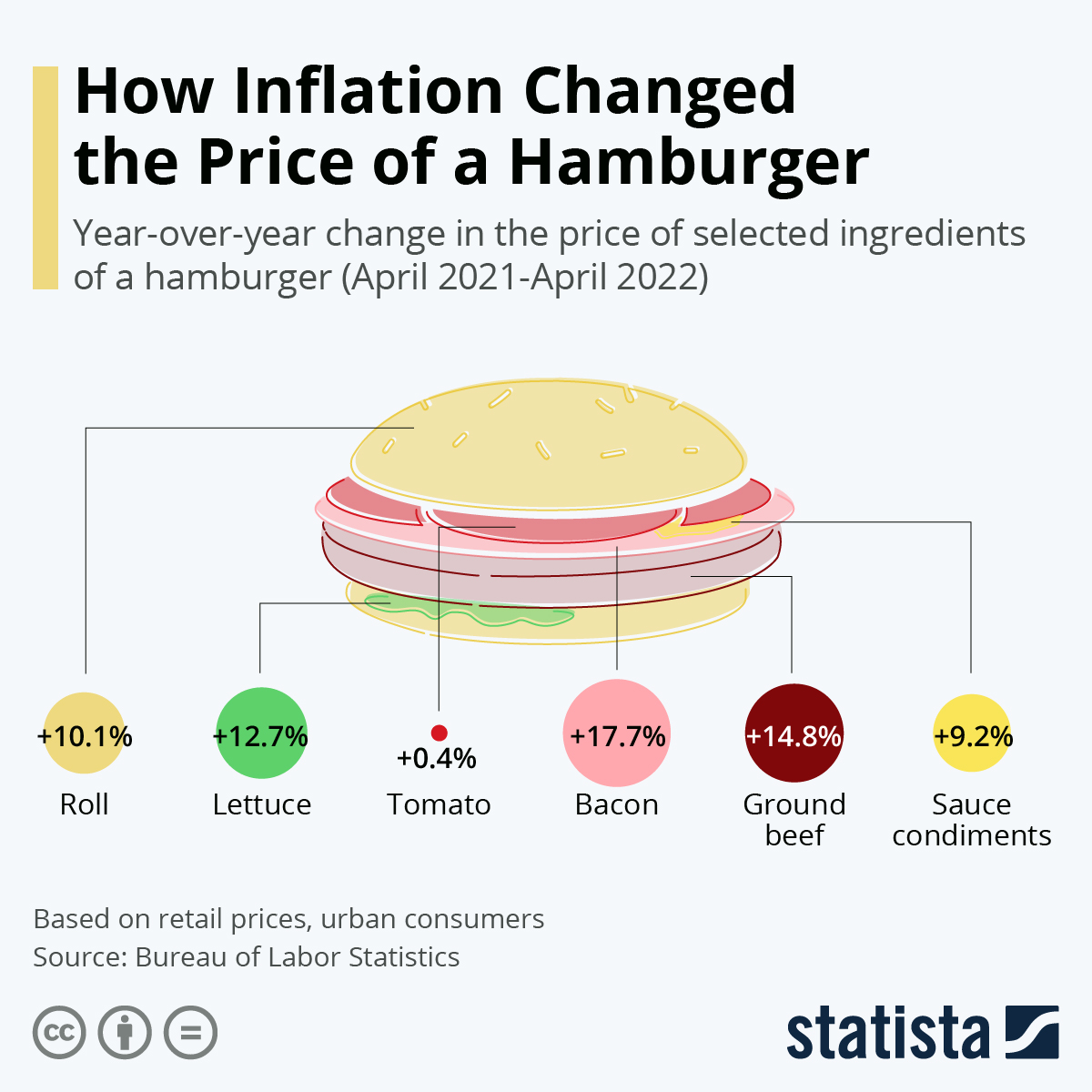
With inflation standing at 8.3% year-over-year in April, everyday items are becoming pricier for U.S. consumers. Food prices in particular took some significant steps up, as seen in the example of shopping for hamburger ingredients.

Meats experienced some of the highest price increases among food items: Ground beef now costs almost 15 percent more than in April 2021 and bacon is 17.7 percent more expensive than one year ago. On the other hand, the price of tomatoes was up just 0.4 percent over the course of one year, showing that some item suffered less inflation than others. At a 6.2 percent price increase, fresh vegetables as a whole saw the lowest rate of inflation of any food category.

Energy – the most volatile item in the Consumer Price Index together with foods - drove overall price increases even more. In short supply following the Russian invasion of Ukraine and ensuing sanctions, energy costs rose by 30.3 percent since April 2021. This increase is independent of the base effect as energy prices had already reached pre-pandemic levels again one year ago.

Inflation had already started to rise in 2021 in the aftermath of COVID-19 lockdowns that continue to affect global supply chains. It was further pushed up by the Russian invasion of Ukraine that saw energy supply disrupted by sanctions and Ukrainian products missing from world markets. As a result, inflation is reaching an increasingly broad range of products. For example, while the price of used cars and trucks had already skyrocketed in 2021, new vehicles have now also become 13 percent more expensive than they had been a year ago.

Given the high price of gas and cars, inflation is indirectly encouraging another sustainable behavior - using public transportation. The category became 2.7 percent more expensive over the past year – a way smaller increase than most other spending categories.

By Katharina Buchholz, Statista

Friday, May 13, 2022


Economic Pressures Likely Will Be Catalyst for Even More Tech Adoption

As this recent article from Isha Marathe of LAW.com suggests Even as the pandemic transformed the way legal operates, it didn't do enough to create a proactive shift toward tech use for many legal departments. Now, with prices rising and budgetary constraints, some expect increased automation even among the more stubborn firms. 

Are you offering your clients convenient and affordable financing alternatives to acquire your products and services? Contact Dean Morrison today to discuss how proactive financing programs can be easily embedded into your sales process and strategy.

Dean Morrison e. dmorrison@dimensionfunding.com  p. 954-224-3390

An economy facing historic upward price pressures might just be the impetus the legal industry needs to move towards even more tech adoption.

To be sure, the COVID-19 pandemic already has pushed the industry to become more tech-savvy. Still, even as legal tech saw the highest growth recently, vendors and legal ops professionals at the Corporate Legal Operations Consortium (CLOC) Conference 2022, said the one goal even the best solution has been unable to accomplish is educating in-house attorneys and general counsel to adopt new tools before they become vital.

Mary O’Carroll, chief community officer at Ironclad and former director of legal operations, technology, and strategy at Google, has seen the world of tech adoption from both sides and believes the legal industry is at its most open-minded when under pressure.

“Change is happening so fast in this industry that is still really tradition-based, so lawyers are still trained the same way at law schools, they are still trained up the same way at law firms. But the expectations around how legal services are delivered and the skill-set you need to be successful are very different now than they were 10 years ago,” O’Carroll said. “So how do we prep general counsel for being open-minded in leveraging technology? How do we prep them to challenge the status quo in how they have always hired someone in legal operations? There is a lot of education [GCs] need to move away from the ‘it’s not broken, we don’t need to fix it,’ [attitude], but legal ops and legal tech thrive when we are in times of economic pressure.”

As evidence, O’Carroll pointed out that legal ops first took off in 2008 in the depths of the Great Recession, creating demand for innovative cost-cutters all around. Now, as the U.S. faces its highest inflation in decades, general counsel are once again going to have to push themselves out of their solution box, which largely consists of spending and hiring.

“Once they have these constraints, [GCs] start thinking, how can I find the legal ops person who will make magic happen? Who can think about leveraging technology so that I can replace four [full-time equivalents] of lawyers with a new tool? Let’s get legal out of the way and automate some stuff,” she said.

Of course, even with new tools meant to automate legal processes pouring into the market, the actual degree of tech adoption even within legal ops remains an elusive metric, said Keesal Propulsion Labs (KP Labs) director of the digital transformation strategy Jeff Marple.

“I don’t think the pandemic has played a big enough role as everyone wants to say it has in tech transformation [of legal ops],” Marple said. “Yes, it’s made people a bit more tech-friendly. Video conferencing and collaboration has accelerated. I wish it was a better story. But how would I even measure it, to begin with? I can say there’s a lot more to automate out there. A lot of things don’t have to be done in the way they are, and I think there’s room for a digital transformation. That’s why I’m in the business I’m in.”

Some legal technology providers share O’Carroll’s view that a serious lack of training and education around technology is to blame for slow adoption within legal departments. But with increasing costs, tech may become a natural solution, pointed out Evisort founder and CEO Jerry Ting.

“Before the pandemic, legal departments [and firms] looked at contract management tools and said, ‘Wow that’s cool, we probably should have done that 20 years ago,’ Ting said. “I think now, it’s becoming less excusable when they don’t have the tool already. It’s a selling point to their clients. But a lack of knowledge holds them back.”

However, that’s not to say there won’t be progress. In the coming years, Ting forecasted “70% or more mundane legal tasks automated” because the cost of manual processes will outweigh the risk-averse nature of many in the legal sector, from firms to in-house attorneys.


Wednesday, May 11, 2022

Working 9 to 5?


After having had a taste of remote working through the pandemic, employees are now yearning for even greater flexibility when it comes to their working hours. According to a report by Adobe, 51 percent of enterprise employees would like to have complete flexibility when it comes to their schedule, in contrast to only 16 percent of respondents who said their ideal work week would have no flexibility at all, but rather “start and end work according to a set work schedule.”

Younger generations in particular appear to care about levels of self-autonomy over their work schedule, with 73 percent of Millennials saying that they would switch jobs to another with greater flexibility if their salary and job description stayed the same, according to the report. At the same time, as Wrike writes, an increase in flexible work schedules may also help gender equality, as parents can share the burden of child care. This trend appears to be gaining steam, as we’ve seen more companies taking up the idea, and even governments, as Ireland now gets set to implement the right to request flexible work arrangements, according to RTÉ.

Times have changed since Henry Ford introduced 8 hour shifts for factory workers, back in the early 1900s. As Forbes writes, living in a service economy is not the same as a manufacturing economy; we now have the technology to connect us with colleagues in different time zones instantaneously, and for many people, at least in the global north, social patterns have completely changed. As Adobe writes, “Employers need to address these challenges, or risk losing top talent.”

By Anna Fleck, Statista


Thursday, May 5, 2022

Interest Rate Increase Announced


WASHINGTON — The Federal Reserve on Wednesday raised its benchmark interest rate by half a percentage point, the most aggressive step yet in its fight against a 40-year high in inflation.

“Inflation is much too high and we understand the hardship it is causing. We’re moving expeditiously to bring it back down,” Fed Chairman Jerome Powell said during a news conference, which he opened with an unusual direct address to “the American people.” He noted the burden of inflation on lower-income people, saying, “we’re strongly committed to restoring price stability.”

The federal funds rate sets how much banks charge each other for short-term lending, but also is tied to a variety of adjustable-rate consumer debt.

Along with the move higher in rates, the central bank indicated it will begin reducing asset holdings on its $9 trillion balance sheet. The Fed had been buying bonds to keep interest rates low and money flowing through the economy during the pandemic, but the surge in prices has forced a dramatic rethink in monetary policy.

Markets were prepared for both moves but nonetheless have been volatile throughout the year. Investors have relied on the Fed as an active partner in making sure markets function well, but the inflation surge has necessitated tightening.