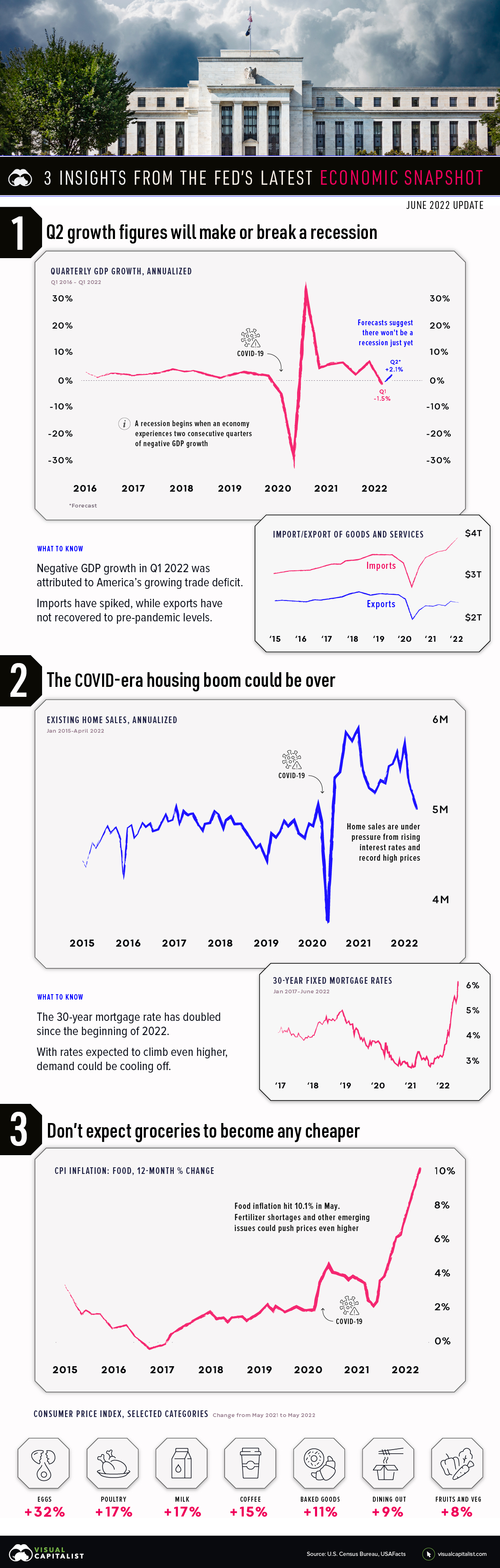
Three Insights from the Fed's Latest Economic Snapshot
Growth Figures, Housing Boom, Groceries to Become Cheaper

Customer Financing Programs Leverage More $ales
Three Insights from the Fed's Latest Economic Snapshot
Growth Figures, Housing Boom, Groceries to Become Cheaper

We just returned from the very successful Automate Conference in Detroit. In speaking with many of the vendors at the show, I was surprised by how many leave the financing decision up to their customer, in other words, they don't proactively take control of the sale by bringing in an expert that is an advocate for them to accelerate sales cycle and close the deal. There is a "real" need for vendors and sales representatives to own the financing process from the top of the sales cycle. Below represent some of the main qualities and value points that we bring to the table:
Contact me to discuss how our customer financing programs add significant value to help leverage and close more sales. Dean Morrison, 954-224-3390, dmorrison@dimensionfunding.com

The top trends driving technology providers in 2022
GUEST
COLUMN BY RAJESH KANDASWAMY
SHAR
Technology’s impact on society and national economies continues
to intensify, in turn increasing the business responsibilities of technology
service providers and what their
customers expect from them.
This deeper
entrenchment in business has also made technology providers much more sensitive
to factors beyond information technology. It’s no longer sufficient for them to
address client needs and provide quality products. Rather, they have to be
aware of the broader economic, social and technological forces that have come
to form a large bearing on their business.
Such forces make up
this year’s top trends for technology service providers, or TSPs for short
(below).
Co-innovation ecosystems
Technology innovation is at the heart of every TSP. However,
in the digital world — with much stronger interconnections among technology
providers, customers, partners and governments — traditional siloed
innovation practices such as research and development and basic product
development will not be enough to survive.
Instead, a
co-innovation ecosystem is an emerging approach that accelerates the
development of solutions to industry problems, spreads risk and cost across the
participants, and drives adoption of the end solution. It enables internal,
external, collaborative and co-creative ideas to be converged and directly tied
to value creation with the “shared revenue/value” among ecosystem
stakeholders and participants.
Engagement,
co-creation and compelling experiences for value creation are at the core of
co-innovation. Product development and the value of co-innovative organizations
are thus difficult to replicate by competitors.
In fact, by 2023, 30%
of all revenue-bearing emerging technology solutions will be developed via
co-innovation ecosystems, enabling vendors to become more competitive and
expand into new markets.
Sustainable business
Sustainable
business is a strategy
that incorporates environmental, social and governance or ESG factors into
decision-making. It is underpinned by sustainable
technology, a framework of
solutions that enable ESG outcomes.
Growing
sustainability-driven product investments and deployments are taking place
across numerous categories such as sustainable IT — for example, cloud
sustainability or green
software development — smart energy infrastructure and circular product
innovation.
In the end, tech
providers that can quantify their offering’s positive contribution to
customers’ sustainability objectives will increase their win rate by 20%
by 2025.
Talent agility
The post-pandemic pace
of TSPs’ business can no longer be accommodated by rigid and fragmented talent
management processes. This is where talent agility comes in – the ability to
support talent needs for business agility through a combination of skills and
talent supply analysis, and by connecting fragmented existing and new talent
pools without borders.
Talent agility will
affect six key areas of TSP business: products and services, customers and
buyers, operations and processes, competitive landscape, and partners and
ecosystems.
By 2025, 30% of TSPs
will create a single talent network to connect up to six separate talent pools,
up from fewer than 5% today.
Digital sovereignty
laws and regulations are growing in scope and accelerating in most major
markets, giving a short-term window for market expansion to solidify a presence
for TSPs.
As competition across
country borders and purview declines, and more restrictive digital usage laws
expand, prices are expected to increase, creating revenue opportunities for
those with scale and reach. Governments, too, will become increasingly aware of
the value of citizen data.
By 2026, nationalistic
and protectionist value-based economic systems will grow 10 times globally,
disrupting more than 80% of all technology companies’ go-to-market and product
strategies. Product leaders will need unique, digitally distinctive
operating architectures that are compliant to social, legal and economic
zones by region.
Democratization of technology
The democratization of
technology empowers non-IT workers to select, implement, produce and custom fit
their own technology. Product
leaders must embrace the
new opportunities this trend offers and meet the needs of a new set of citizen
developers and business
technologists, or struggle to
deliver compelling solutions and experience eroding market positions.
After all, by
2024, 80% of technology
products and services will be built by those who are not full-time technical
professionals.
Intelligent applications
Intelligent
applications use data and machine learning to generate a continuous learning
system that provides adaptive and contextualized experiences. For example,
emerging intelligent applications might generate new financial products and
services based on customer data or create new customer experiences such as
autonomous business operations in retail stores or automated workflows and
fleets within mining.
Enterprise
stakeholders intuitively embrace the principles and promises of intelligent
applications, and will only continue to do so. In a recent Gartner end-user
survey focused on emerging technology adoption, the mean investments in
intelligent applications over the past 12 months was $408,000, and the mean
value of planned investments in intelligent applications within 2022 is
$618,000.
Distributed enterprise
Organizations are
shifting toward “distributed enterprise” to support hybrid work, remote
delivery and digital experience at all touch points. In this business model,
there is growing demand for technology solutions and tools that can support a
predominantly non-office workplace and accelerated digital transformation
initiatives to support distributed delivery for clients.
Tech providers must
respond to these shifts by prioritizing technologies and product capabilities
that blend the digital and physical worlds. By 2023, 75% of organizations that
exploit distributed enterprise benefits will realize revenue growth 25% faster
than competitors.
Composable business
Composable
business is a concept
where leaders can quickly build new business capabilities by assembling digital
assets in an organization that is architected for real-time adaptability and
resilience in the face of uncertainty. It impacts all facets of tech providers’
business as it enables enterprises ability to respond to the market and seize
digital opportunities faster and cheaper.
Seven percent of
respondents in the 2022
Gartner CIO and Technology Executive Survey indicated that they have already invested in composable
enterprise, but an additional 60% expect to have done so by the end of three
years.
Composable business is
certainly a market shift but does open up new markets for TSPs.
Beyond intellectual property
Historically,
protecting and controlling ideas and inventions equaled advantage. IP
strategies such as patents represented a powerful way of generating value and
are the cornerstone of traditional high-tech strategies. But their role is
changing.
“Beyond IP” recognizes
the rise of alternative approaches for realizing value from ideas, inventions
and other proprietary assets. Rather than creating proprietary IPs with finite
boundaries to be defended, new leaders seek a pool of ideas and insight with
fluid boundaries whose value increases through application that builds the next
set of ideas.
IP and intellectual
capital or IP/IC protection strategies based on “fixing ideas” into patents and
so forth will reduce the value of the IP/IC by up to 50% over the next five
years.
Unlimited capital
Unlimited capital is
the trend in which there is such an abundance of capital competing for
investment in private companies, that tech providers have access to virtually
unlimited amounts of capital at a low cost. Startups that can successfully
demonstrate product market fit can raise dramatically larger rounds of
financing at earlier stages of development, allowing them to accelerate growth
without regard to capital efficiency or risk.
Rajesh
Kandaswamy (@rajeshakan) is a distinguished analyst vice
president and fellow at Gartner Inc. who advises C-level executives and product
leaders on the strategic impact of emerging technologies. He wrote this article
for SiliconANGLE. Join Rajesh and his colleagues at the Tech
Growth & Innovation Conference, taking place virtually July 12-13, 2022.

Increase Your Business by Offering Point of Sale Financing
In this blog post from Erik Mcfrazier – CEO at Pacific IT Support, and one of my colleagues from BCPA and IAMCP - he very clearly connects the dots to make the case that businesses are spending on IT as an investment and not as a cost.
“Many businesses no longer see IT as a cost. They embrace it as an investment. They can see the direct correlation between creating robust, safe, and flexible systems – and their teams’ abilities to achieve more. Owners and managers are also placing more value on excellent, proactive technology …”
Your ability to include creative and timely
financing programs provides your clients with the ability to make these important
investments in their business….I’m here to help you create messaging that will
resonate with your clients and leverage more…and more profitable sales! Dean Morrison,
954-224-3390

Businesses are
spending more on IT this year
Posted by Pacific IT Support On April 29, 2022
By Erik Mcfrazier
As a business owner or manager, you
know how important good IT is. Your business couldn’t function without
it.
Your IT isn’t just about computers and data. It’s everything from your phone system to your printers, to where you access your documents.
And that’s without going into the measures you must take to keep your data and infrastructure safe and secure from cyber criminals. So, we weren’t surprised by a new forecast from IT research and consultancy firm, Gartner, which predicts businesses will spend more on technology this year.
In fact, the global IT spend could reach an enormous $4.4 trillion. That’s despite rising inflation, the Russian invasion, and shortages in both chips and IT talent. We believe there’s been a fundamental shift in the way businesses view their technology.
Two years ago, at the beginning of the pandemic, companies were forced to take unexpected urgent action to help employees work from home. In many cases that meant a large investment in devices, rapid changes to systems, and the adoption of new technology.
And it’s worked out well for most. Businesses have adapted quickly, and many have embraced the changes on a more permanent basis. But it’s also made business leaders realize they need to be better prepared to respond to future potential disruption.
This is the difference between a flexible and agile business… and one that stumbles at the first hurdle.
Many businesses no longer see IT as a cost. They embrace it as an investment. They can see the direct correlation between creating robust, safe, and flexible systems – and their teams’ abilities to achieve more. Owners and managers are also placing more value on excellent, proactive technology support from a trusted partner.
To not only plan and execute big development projects. But also, to help reduce downtime and ensure systems are secure and running as they should be. If you’re reviewing your spend on technology and support, we can help.
